
Pitman Shorthand for Beginners: Where to Start and What to Learn First
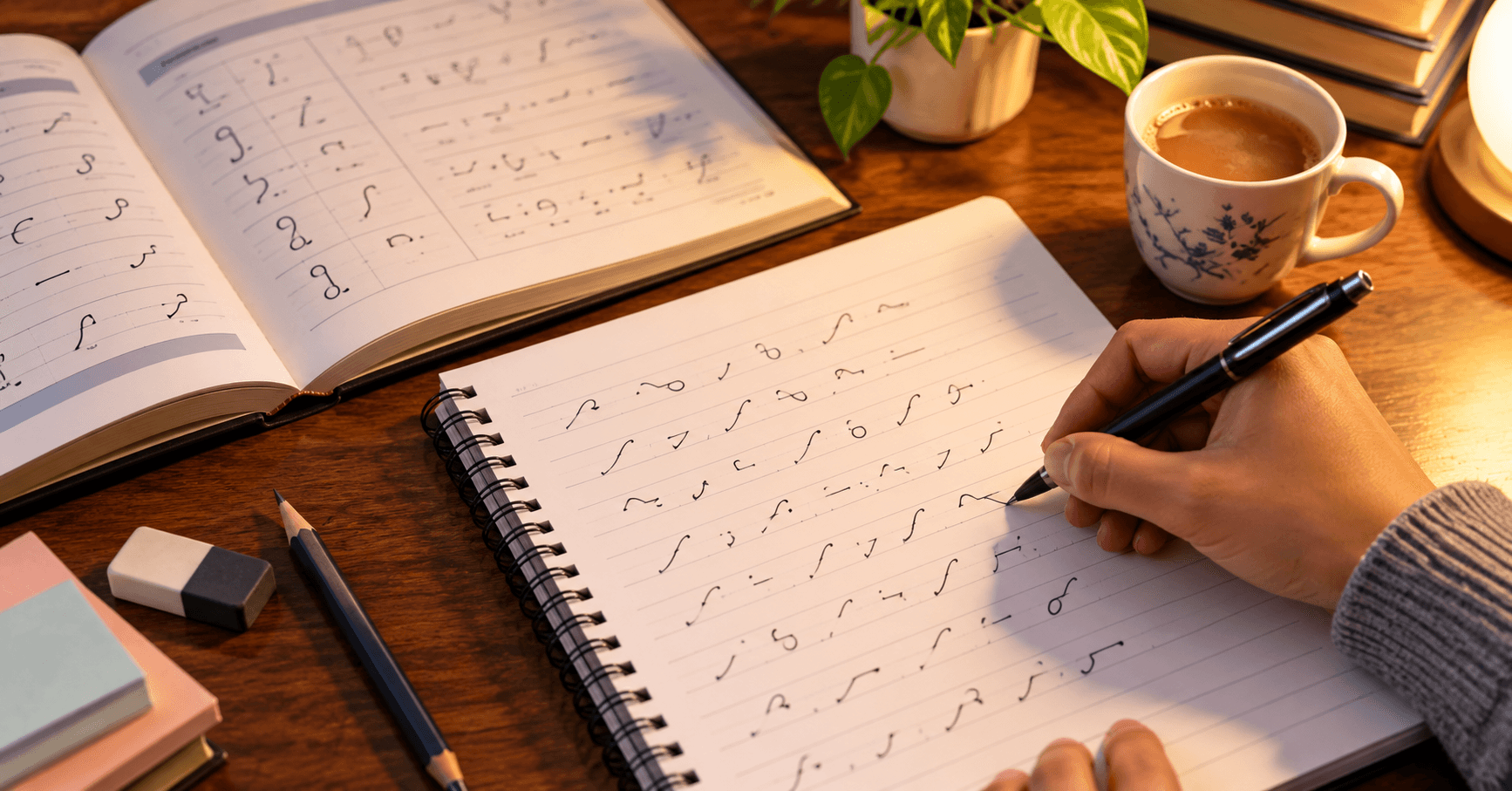
Pitman shorthand writes words by their sounds using strokes, shading and position instead of letters. Beginners should learn it in a fixed order: consonant strokes first, then vowels, then short forms and phrases, practicing each stage by reading and writing before moving on.
Key takeaways
- Pitman is phonetic: you write what you hear, not how a word is spelled.
- Learn the strokes and vowels in order and do not skip units.
- Read outlines as much as you write them.
- Short daily practice beats occasional long sessions.
How Pitman shorthand works
Each sound has a stroke. Thin and thick strokes show related sounds, the direction and length of a stroke change its meaning, and a small mark placed beside a stroke shows the vowel. Position relative to the line adds more information. It looks like a lot at first, but the rules repeat, so they become automatic.
A sensible study order
- Consonant strokes: straight and curved strokes and their thick and thin forms.
- Vowels: the first, second and third place vowels and where they sit beside a stroke.
- Joining strokes: writing whole words by linking outlines smoothly.
- Special forms of R and H: when to use each form and why.
- Short forms and phrases: the common words that make real speed possible.
The Pitman section of StenoKendra follows a New Era style theory course, so you can work through the units in order.
How to practice from day one
- Read: read outlines aloud and check your answers.
- Write: copy each new outline several times, neatly.
- Recall: use flashcards to test yourself without looking.
- Dictate: once you know a unit, take simple dictations using only the outlines you have learned.
Mistakes beginners make
- Writing outlines too small or too large, which hurts reading later.
- Skipping short forms, then being stuck at low speed.
- Never reading back, so errors are not noticed.
- Rushing to speed before the theory is solid.
How long does it take?
Most learners need to complete the theory first and then spend several months building speed. Your own timeline depends on how often you practice, so plan a steady daily routine.
What you need to get started
- A notebook with lined pages, since shorthand is written on the line.
- A soft pencil or a smooth pen that lets you write thin and thick strokes easily.
- One theory course that you follow in order.
- A timer, so you can start short timed practice early.
A realistic first-month plan
Week 1: learn the consonant strokes and practice each one until it is smooth. Week 2: learn the vowels and where to place them, and read simple outlines. Week 3: write short words by joining strokes, and start flashcards. Week 4: learn your first short forms and take a very slow dictation using only what you have learned. This pace is gentle on purpose. Solid foundations save months later.
How to memorize outlines without getting overwhelmed
Use spaced repetition: review new outlines the same day, then the next day, then after three days and after a week. Group outlines by pattern so you learn the rule, not each word on its own. The outline flashcards keep track of the ones you know, so you spend time on the ones you forget.
Signs you are on the right track
- You can read back your outlines the next day.
- You hesitate less when forming common strokes.
- You can write a short sentence from dictation without stopping.
Frequently asked questions
Is Pitman shorthand hard to learn?
It takes patience, but the rules are logical. Learning in order and practicing a little every day makes it manageable.
Do I need a teacher to learn Pitman shorthand?
A teacher helps, but a structured course with regular reading, writing and dictation practice also works well for self-learners.
Which Pitman book should I follow?
Many learners use the New Era course. The key is to follow one course in order rather than mixing several.
Can I learn Pitman shorthand online?
Yes. You can follow theory lessons, flashcards and timed dictations online and track your progress.
When should I start dictation practice?
As soon as you finish the basic strokes and vowels. Start with simple, slow dictations using only outlines you know.