
How to Practice Steno Dictation Online: A Daily Routine That Works
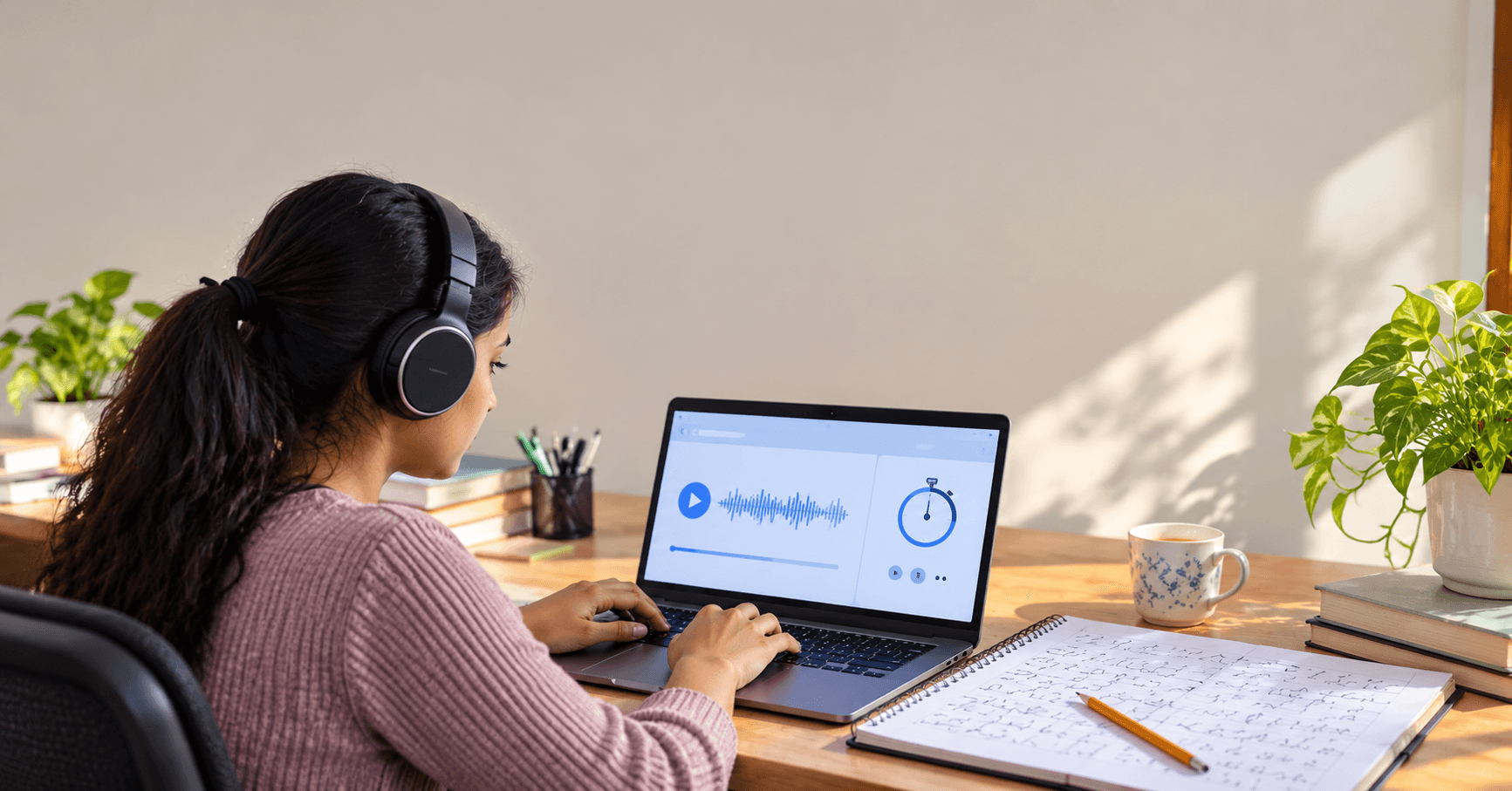
The best way to practice steno dictation online is to follow the same short routine every day: warm up, take one timed dictation, transcribe it, review your mistakes and spend a few minutes on vocabulary. About 90 minutes a day, done consistently, beats long irregular sessions.
Key takeaways
- Consistency matters more than session length.
- Practice in exam conditions: headphones, no pausing, a physical keyboard.
- Review is where most of your improvement happens.
- Change one thing at a time, either speed or accuracy.
Set up your space first
Use a laptop or desktop with a physical keyboard, a pair of headphones and a quiet room. Online practice only helps if it feels like the real test, so avoid practicing on a phone for transcription.
The 90-minute routine
1. Warm-up (10 minutes)
Write a few lines of shorthand from memory or revise outlines you often forget. For Pitman learners, the outline flashcards are a good warm-up.
2. One timed dictation (15 to 20 minutes)
Pick a dictation at your working speed. Listen, write, and do not pause the audio. Treat it like the real test.
3. Transcription (20 to 30 minutes)
Type your transcription from your shorthand notes within the time limit. Do not look at the reference text until you have submitted.
4. Mistake review (20 minutes)
Open your result and study every mistake. Ask why it happened: unclear outline, missed word, spelling, or typing slip. Write down the top three causes for the day.
5. Vocabulary (10 minutes)
Revise the words you got wrong using the word library, and write each of them a few times.
How to progress week by week
- Weeks 1 and 2: accuracy first, at a comfortable speed.
- Weeks 3 and 4: repeat weak passages and raise speed by one level.
- Weeks 5 onward: add a weekly timed mock from the test series.
Habits that make online practice work
- Practice at the same time every day.
- Keep a notebook of recurring mistakes.
- Do not skip transcription, even on busy days.
- Take one full rest day each week to avoid burnout.
Adjusting the routine to your time
Not everyone has 90 minutes. If you have only 45 minutes, keep the structure but shorten each block: a 5-minute warm-up, one 10-minute dictation, 15 minutes of transcription, 10 minutes of review and 5 minutes of vocabulary. The order matters more than the length. If you have more time, add a second dictation rather than extending the review, so you keep working at a good pace.
Common problems and fixes
| Problem | Likely cause | Fix |
|---|---|---|
| Falling behind the audio | Speed is too high or outlines are slow | Drop one speed level and rebuild |
| Cannot read your own notes | Rushed or oversized outlines | Write smaller and neater for a week |
| Many typing slips | Typing practice is missing | Add 20 minutes of typing daily |
| Losing motivation | No visible progress | Track weekly accuracy and celebrate small gains |
How to stay consistent
Attach practice to something you already do, such as right after breakfast. Keep your headphones and notebook where you can see them, and decide the night before which dictation you will do. Missing one day is fine; missing three starts a pattern. If a day goes wrong, do a short 20-minute session instead of skipping it completely.
Ready to put this into practice? Browse the dictation catalog, pick a speed that fits your level, and get an instant mistake breakdown after every attempt. Create a free account to save your progress.
Frequently asked questions
How many hours should I practice steno daily?
Most aspirants do well with 90 minutes to 3 hours a day, depending on their exam date. Focus on regularity and review rather than raw hours.
Is online dictation practice as good as offline practice?
It is very effective when you use headphones, a physical keyboard and exam-style timing, and it gives instant scoring that offline practice cannot.
Should I pause the audio while practicing?
Avoid it during timed attempts, because the real test does not allow pauses. You can listen in practice mode beforehand.
What if my accuracy drops when I increase speed?
Step back one level, repeat passages until accuracy recovers, then try again. Speed built on poor accuracy does not last.
How do I know if I am improving?
Compare your accuracy and mistake types across attempts. Your My Dictations page shows these trends after you sign in.